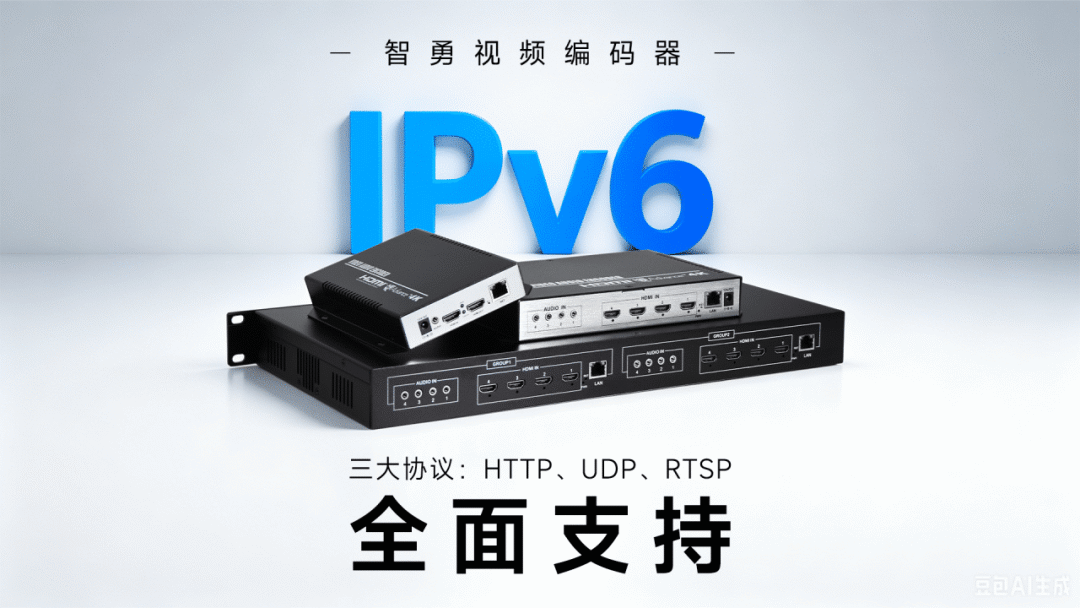
IPv6 Science Popularization: What is IPv6 and What Does It Have to Do with Yourself?
You may have heard of IPv6 or seen this term in router settings, but you haven't figured out what it really is or what it has to do with yourself.
It's okay, in today's article, we will use the simplest way to clarify three things for you:
- What is IPv6?
- What is the difference between IPv6 and IPv4?
- Wisdom and courageVideo EncoderIPv6 Support Scheme
What is IPv6?
Start withIP addressSpeaking of it.
We go online every day, watching videos, watching surveillance footage, and transferring files - the essence of these operations is that devices are sending data to each other. To ensure accurate delivery of data, each connected device needs a unique identifier, just like your house number. This number is calledIP address。
The most widely used currently isIPv4The protocol can provide approximately the following IP addresses4.3 billion。
4.3 billion may sound like a lot, but think about it: with 8 billion people worldwide, each person owning a mobile phone is 8 billion, plus computers, cameras, tablets, smart devices... 4.3 billion is simply not enough. In fact, as early as 2011, global IPv4 addresses had already been officially allocated.
In recent years, NAT (Network Address Translation) technology has been used to allow multiple devices to share a common public IP address to "extend their lifespan", but this is ultimately a temporary solution.
So, IPv6 has arrived.
IPv6 is the sixth version of the Internet protocol,The biggest change is that the address length has been extended from 32 bits to 128 bits.
32 bits can represent approximately 4.3 billion addresses, how many bits can 128 bits represent?
About 3.4 × 10 ³ ⁸ pieces.
How big is this number? ——For example, every grain of sand on Earth can be assigned an independent IP address, and there is also a lot of surplus.
Example of IPv6 address format: 2001:0db8:85a3:0000:0000:8a2e: 0370:7334
It seems much more complex than 192.168.1.1 in IPv4, but for devices, this is an essential upgrade.
Simple summary: IPv6 is the next generation of IP address system, with more addresses and so many that it is completely unusable.
What is the difference between IPv6 and IPv4?
Having multiple addresses is just the most intuitive advantage of IPv6, in fact, it is stronger than IPv4 in many aspects. Let's make it clear with a table:
| Comparison item | IPv4 | IPv6 |
|---|---|---|
| Address length | 32-bit | 128 bit |
| Number of addresses | Approximately 4.3 billion | About 3.4 × 10 ³ ⁸ |
| connection method | Most devices are located behind NAT and cannot be directly accessed from the external network | Each device has an independent public network address that can be directly accessed |
| safety | Encryption is not default and requires additional configuration | Native support for IPsec, data transmission itself encrypted |
| transmission efficiency | Baotou is more complex and divided into multiple sections | Simplified packet header, faster routing processing, and higher transmission efficiency |
There are several points worth discussing here:
Regarding the Connection Method
In the IPv4 era, the vast majority of devices are hidden behind NAT, and external networks cannot directly access internal network devices. doremote monitoringEveryone knows that just penetrating NAT requires a lot of effort. Each device in IPv6 has an independent public network address, which can be directly accessed from the outside, eliminating the need for NAT translation,The connection is simpler and the latency is lower.
Regarding Security
In the IPv4 era of network communication, encryption is not default and requires additional configuration. IPv6 natively supports IPsec at the protocol level,The data itself is encrypted during transmission,Security has a basic guarantee.
Regarding Efficiency
The packet header of IPv6 has been streamlined by removing unnecessary fields, making it faster for routers to process. Simultaneously supporting larger MTU (Maximum Transmission Unit) reduces the situation of data fragmentation,The overall transmission efficiency is higher.
One sentence summary: IPv6 is not just about having more addresses, it is stronger than IPv4 in terms of connection methods, security, and transmission efficiency.
IPv6 Support Scheme for Orivision Video Encoder
After discussing what IPv6 is and where it is stronger than IPv4, let's return to our own product.
Orivision Electronics'Video Encoder,We have fully supported IPv6This is reflected in two aspects:
Network layer: Supports IPv6 addresses
Our video encoder supportsManually configure IPv6 addressAfter configuring parameters such as IPv6 address, subnet prefix length, default gateway, etc., normal communication can be achieved in the IPv6 network.
At present, IPv6 addresses need to be manually configured and DHCPv6 automatic acquisition is not supported.
Transport Protocol Layer: Three major protocols fully support IPv6
The core value of a video encoder is to encode the video and output it, and the transmission relies on the protocol. Our video encoder operates on the following three mainstream transmission protocols:,All support IPv6:
① HTTP (Hypertext Transfer Protocol)
HTTP is used for remote management of video encoders. After supporting IPv6, users can directly access the device's web management interface through a browser using an IPv6 address to perform parameter configuration, status viewing, firmware upgrades, and other operations. At the same time, the API interface of the video encoder also supports IPv6 calls, making it easy for third-party platforms to integrate.
② UDP (User Datagram Protocol)
UDP is one of the most commonly used protocols in video streaming transmission, and its advantages areLow cost and low latencyIt is very suitable for monitoring scenarios that require high real-time performance. After supporting IPv6, video streaming data can be efficiently transmitted over IPv6 networks through UDP protocol, meeting the low latency requirements of real-time monitoring.
③ RTSP (Real Time Streaming Protocol)
RTSP is a standard protocol in the video surveillance industry, and is widely used in mainstream monitoring platforms NVR、 Players such as VLC support pulling video streams through the RTSP protocol. Our video encoder supports RTSP over IPv6, which means that the monitoring platform can directly pull data using the RTSP protocol over an IPv6 networkVideo EncoderReal time video streaming,Realize seamless integration at the platform level。
In conclusion
IPv6 is not the future, it is already the present.
The country is vigorously promoting the large-scale deployment of IPv6, operator networks are upgrading, government private networks are upgrading, and more and more project tenders have included IPv6 support as a mandatory requirement.
Our video encoder is ready.
The network layer supports IPv6 addresses, while the transport layer HTTP, UDP, and RTSP protocols all support IPv6. If your project has IPv6 requirements or would like to learn more about product details, please feel free to contact usContact Us。